Synchronized Breathing App for Couples · Science-Backed

One breath.
Two souls.
Every morning.

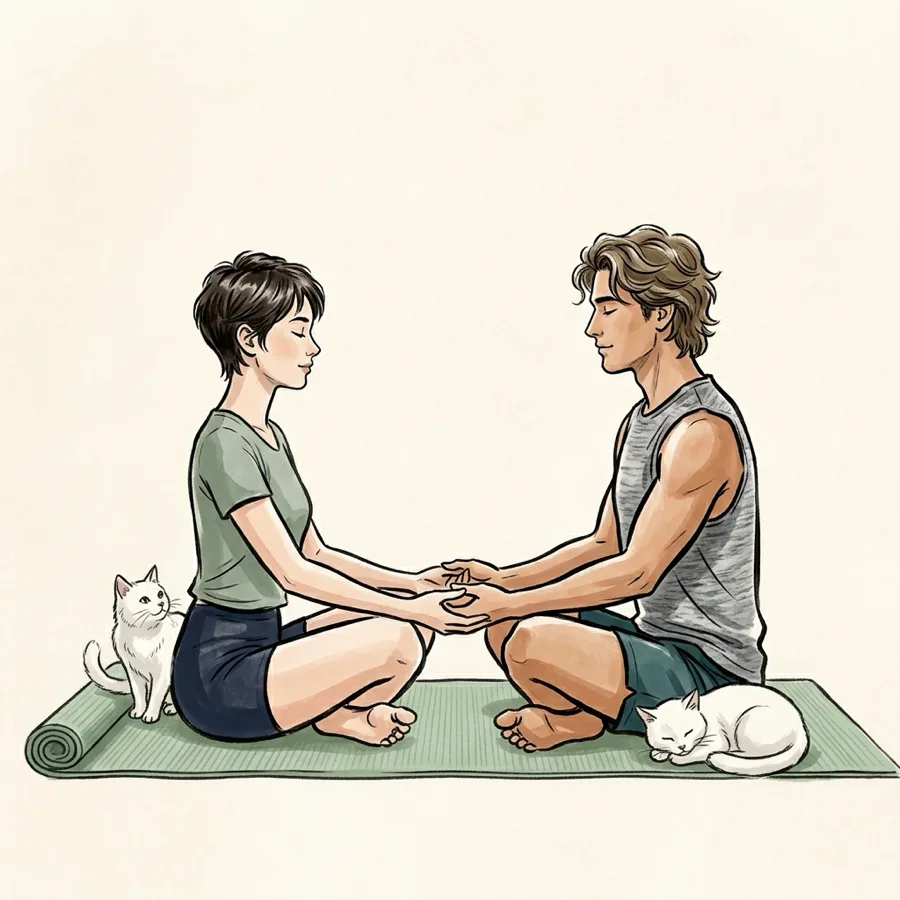
After seven years together, we realized we needed more than love. We needed a ritual. Every morning we open the window, welcome the day, and start breathing together, hand in hand. Synchronizing our breath, our hearts, our souls.

15-25 min Morning ritual
3 acts Breathe · Read · Connect
2 hearts Measurably in sync
Scroll

Seven years of love.
Then the real work began.
2:00
4s In 4s Hold 6s Out
Stamina Breathing

The first years were effortless. The oxytocin rush, the butterflies, the can't-stop-thinking-about-you phase. Science calls it "passionate love" — and neurochemistry research shows it peaks in the first 18 months, then gradually fades by year three to seven.

By year seven, we were still deeply in love — but something had shifted. The automatic chemistry that once carried us had quieted. We realized: love wasn't going to sustain itself. We needed couple routines. We needed to choose connection, deliberately, daily.

"Every morning we open the window, welcome the day together, and start breathing — hand in hand. The first positive routine of the day. Our nervous systems align before the world pulls us apart."

What started as a quiet experiment on a Sunday morning became the most precious part of our day. We now look forward to it more than coffee. More than checking our phones. More than anything that follows. Fifteen minutes that belong only to us.
After the oxytocin fades,
what carries you?

Helen Fisher's fMRI research at Rutgers shows the dopamine-driven "high" of early love lasts 12–18 months. John Gottman's longitudinal studies confirm: the first seven years are the highest-risk period for relationships. Not because love dies — but because the automatic chemistry that sustained it does.

The neurochemistry fades

Passionate love — driven by dopamine, norepinephrine, and serotonin drops — has an expiration date. Elaine Hatfield's research shows it peaks in years 1–2 and declines significantly by year 3–7.

Companionate love must be built

The deeper love — based on trust, intimacy, and commitment — doesn't arrive automatically. Robert Sternberg's triangular theory shows it requires deliberate cultivation. It's a practice, not a feeling.

Without rituals, you drift

Gottman's data is stark: couples who "turn toward" each other's bids for connection 86% of the time stay together. Those who divorce? Only 33%. Daily rituals make the difference.

Love is not a feeling. Love is a practice.

Harvard professor Dr. Arthur Brooks — social scientist, bestselling author, and columnist for The Atlantic — has spent years translating happiness research into actionable strategies. His work on love after the passion phase resonated deeply with our journey.

Dr. Arthur Brooks — Harvard Business School & Kennedy School
"Falling in love is involuntary. Staying in love is a choice and a practice. The goal is not to recapture the high of early love. The goal is to build something better — deeper, more real, more chosen."

Brooks identifies Family as one of four pillars of lasting happiness, alongside Faith, Friendship, and meaningful Work. He advocates for what he calls "happiness hygiene" — daily practices that maintain emotional health the way brushing teeth maintains dental health. For couples, he prescribes sacred rituals: small daily acts protected from the chaos of life. A morning breathing practice, a shared reflective moment, presence before productivity.

From "Build the Life You Want" (2023)

Love Improves With Practice

"Love, like getting happier, is something you will get better with practice. It becomes more automatic with repetition. It becomes a habit over time." Brooks compares the transition from passionate to companionate love to a startup becoming an established company — the skills needed change entirely.

From "From Strength to Strength" (2022)

The Second Half of Love

"The second half of life asks us to move from fluid intelligence to crystallized intelligence — from innovation to wisdom. The same applies to love." Happy long-term couples treat their relationship like a practice: daily, disciplined, intentional.

Why we close our eyes, not open an app

Our concept is built on a fundamental insight from neuroscience and Dr. Arthur Brooks' work: the right hemisphere of your brain is the seat of emotional attunement, embodied presence, and nonverbal connection. It cannot be accessed through logic, language, or screens. Only through the body, the breath, and shared rhythm.

This is why TwoBreath prioritizes listening over screen time. The visual animation is there as a gentle guide, but the real practice happens with eyes closed, hand in hand, following the voice. When you breathe together without visual distraction, the right brain activates fully. The same hemisphere responsible for reading your partner's emotions, feeling their presence, and experiencing spiritual connection.

Right Hemisphere — Iain McGilchrist, "The Master and His Emissary"

The Right Brain Sees the Whole

The left hemisphere analyzes, categorizes, and controls. The right hemisphere attends to the living, embodied, relational world — it reads faces, feels music, senses the unspoken. When couples breathe together with eyes closed, they shift from left-brain "doing mode" to right-brain "being mode."

Arthur Brooks — "Build the Life You Want" (2023)

Sacred Rituals Bypass the Analytical Mind

Brooks argues that the happiest couples create "sacred rituals" — daily practices protected from the chaos of life. These rituals work precisely because they don't require thinking, planning, or talking. They activate the right brain's capacity for presence, attunement, and felt connection.

Why Audio-First, Not Screen-First

Close Your Eyes. Listen. Feel.

Screens activate the left brain — analyzing, reading, processing visual information. But when you close your eyes and simply follow a voice guiding your breath, the right hemisphere takes over. You become aware of your partner's breathing rhythm beside you. You feel the warmth of their hand. You sense their presence without seeing them. This is the neurological foundation of TwoBreath: we use audio guidance (Matthi or Dascha's voice) as the primary experience, with the visual flower animation as an optional secondary guide — because the deepest connection happens when you stop looking at a screen and start feeling the person beside you.

What happens when two people breathe together

The science is compelling: synchronized breathing between partners creates measurable physiological and neurological changes. This isn't wellness speculation — it's peer-reviewed research from leading universities.

Emilio Ferrer — UC Davis, 2012

Partners' Bodies Synchronize Automatically

Ferrer's lab demonstrated that romantic partners exhibit coregulation of heart rate and respiration just from proximity. Intentional breathing together accelerates this dramatically — aligning heart rate variability, cortisol rhythms, and brainwave patterns.

2 min

to measurable physiological alignment during intentional synchronized breathwork.

Pavel Goldstein — University of Haifa, 2018 (PNAS)

Touch + Breath = Amplified Synchrony

When partners held hands during synchronized breathing, their heart rates coupled more tightly and this was associated with measurable pain reduction. The "touch-empathy" effect shows physical contact amplifies breath-based physiological synchrony.

Stephen Porges — Polyvagal Theory

The Vagus Nerve: Your "Rest & Connect" System

Slow, deep breathing stimulates the vagus nerve, activating the parasympathetic "rest and connect" response. When two people breathe together, their vagal tone synchronizes — creating a shared state of safety and openness that Porges calls "co-regulation."

Quanta Magazine, 2022 — Interbrain Research

Brain-to-Brain Neural Coupling

Neuroimaging reveals romantic couples display brain-to-brain synchrony in temporal-parietal structures linked to empathy and emotional regulation — neural coordination that simply doesn't occur between strangers.

HeartMath Institute — Heart Coherence Research

Your Heart's Electromagnetic Field Reaches Your Partner

When you achieve heart coherence through rhythmic breathing, your heart generates an electromagnetic field detectable several feet away. Partners breathing together in close proximity literally entrain each other's heart rhythms — creating what HeartMath calls "physiological coherence." This is the scientific basis for what we feel intuitively: that breathing hand in hand creates a shared state of calm and connection that transcends the individual.

Side by side in the morning light. Eyes closed. Hands intertwined.

We lay side by side in our warm and cozy bed. The room is still quiet. One of us reaches over and opens the window just enough to let in the cool morning air. We hold hands. Close our eyes. And begin. Before the phone. Before the news. Before the world. This moment is ours alone.

01

Breathe Together

Synchronized breathwork, hand in hand. Eyes closed, following Matthi or Dascha's voice. In through the nose, hold, out together. Your nervous systems entrain. Heart rates align. Cortisol drops. The vagus nerve activates. The right brain awakens to presence.

3–15 minutes
02

Read Together

A romantic poem, a philosophical thought, or a sacred passage. Spoken aloud by one partner while the other listens with closed eyes. Not a discussion. Not analysis. A shared experience of language and beauty that opens the heart and deepens the connection built through breath.

1–3 minutes
03

Deep Connection

Open your eyes. Look at each other. Deep, sustained eye contact. The kind you shared when you first fell in love. Hold hands, embrace, feel each other's warmth. No words needed. Just two people fully present, fully seen, before the day begins.

1–3 minutes
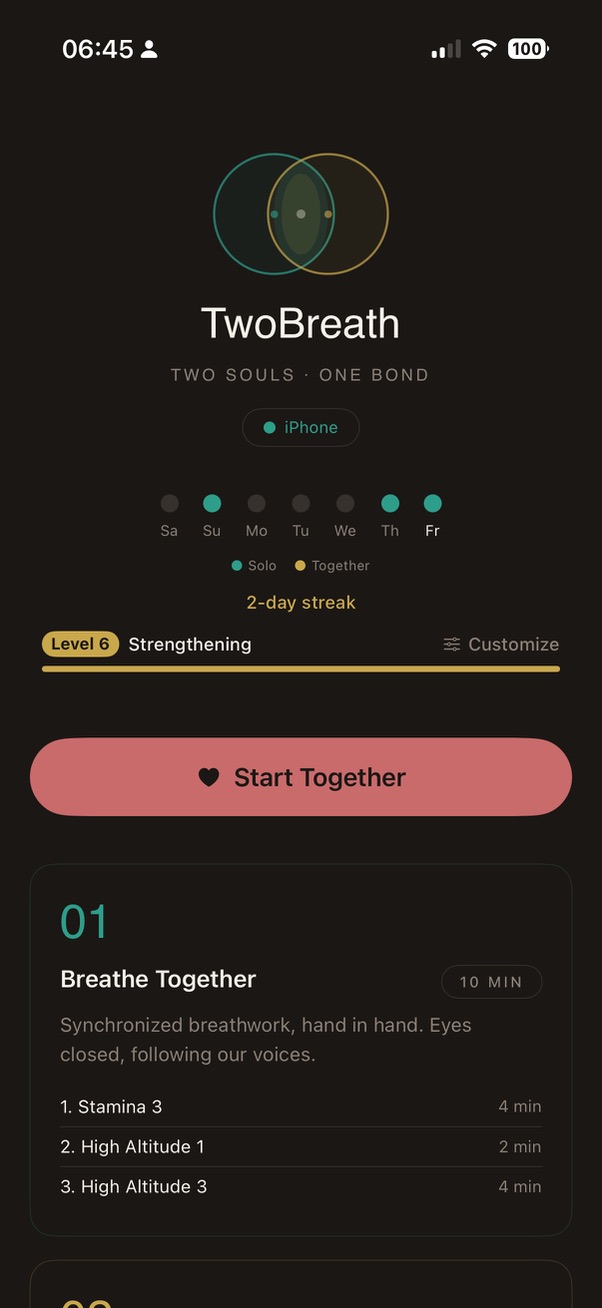
TwoBreath iPhone home screen showing today's Strengthening level 6 routine and the Start Together button
iPhone — Start Together
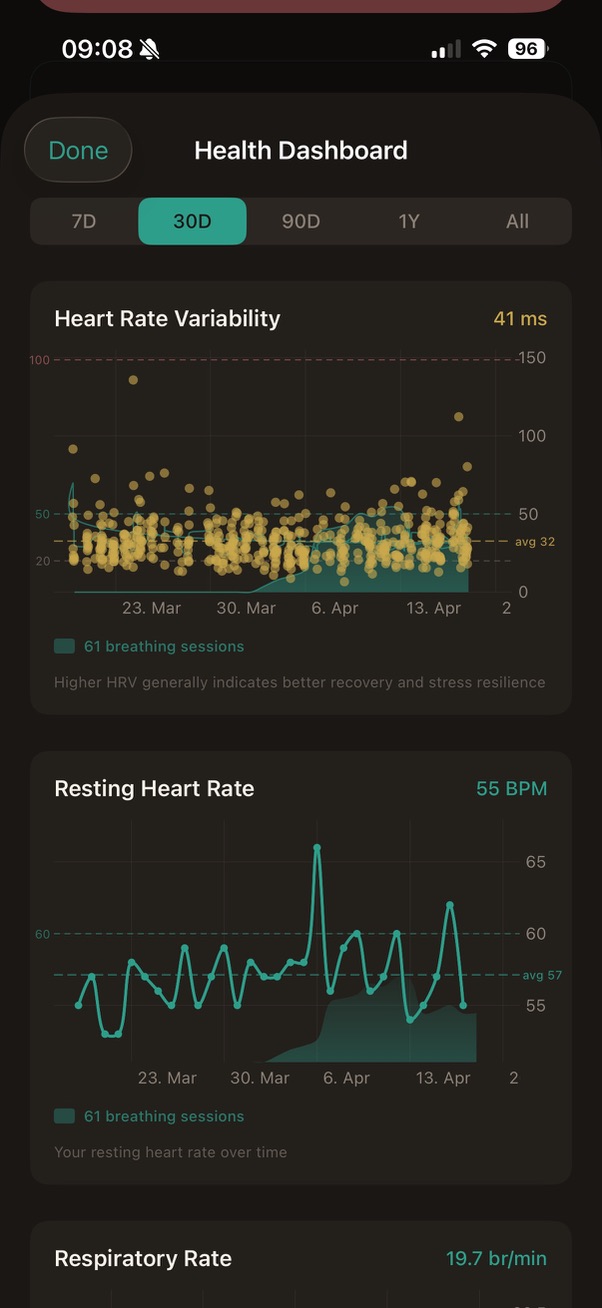
TwoBreath Health Dashboard showing HRV and resting heart rate trends across 61 breathing sessions
iPhone — Health Dashboard
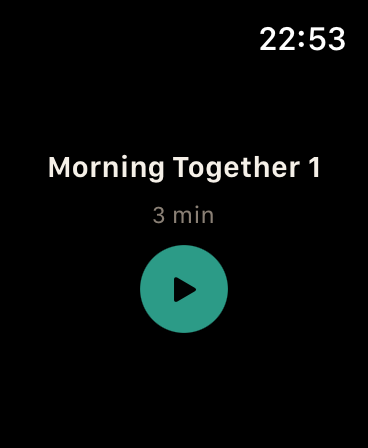
Apple Watch showing today's Morning Together 1 session ready to start
Apple Watch — Today's session

Can we prove it? We want to find out.

We wear our Apple Watches during every morning session. The question that drives us: do our hearts actually synchronize? Can we measure the effect of TwoBreath on our physiology — heartbeat, HRV, and beyond? Research says yes. We want to see it in our own data.

Heart Rate Sync

BPM

Ferrer (UC Davis) and Goldstein (Haifa) proved partners' heart rates couple during shared breathing. We want to see our Apple Watch heart rates converge in real time.

HRV Coherence

SDNN

Heart Rate Variability reflects autonomic nervous system balance. Bar-Kalifa's research (2016) showed HRV synchronization between partners is a marker of emotional attunement.

Respiratory Rate

RPM

Apple Watch tracks respiratory rate during Mindfulness sessions. Coherent breathing at 5–6 breaths/minute maximizes vagal tone — the "sweet spot" identified by Stephen Elliott's research.

Cardio Fitness

VO2

While VO2Max is measured during activity, improved HRV through daily breathwork correlates with better cardiovascular fitness markers over time (Brown & Gerbarg research).

The Research Foundation for Wearable Couple Measurement

What Science Already Knows

Sels et al. (2020, KU Leuven) used wearable sensors to measure autonomic synchrony in couples during daily life and confirmed heart rate synchrony in real-world settings. Timmons, Margolin & Saxbe (USC, 2015) found partners showed correlated respiratory sinus arrhythmia (RSA) — a key HRV component — throughout the day, with stronger linkage during shared activities. Hernando et al. (2018) validated that Apple Watch PPG-based HRV measurements correlate highly (r = 0.7–0.9) with clinical-grade ECG for time-domain metrics. The hardware is ready. The science is clear. We just need the app to connect the data from two watches during a shared breathing session.

Where this practice can take you.

Some mornings, travel or life separates us. But the ritual does not have to stop. Our vision is a way for couples to connect through synchronized breathing. Feeling each other's presence through shared rhythm, even across time zones.

And beyond distance. Breathing together is the foundation of everything that makes two people feel truly close.

Side by Side with Health Insights

Our current practice: open the window, hold hands, and breathe. An app that reads both Apple Watches simultaneously and shows a live sync score. How closely our heart rates, HRV, and breathing align. The invisible bond made visible.

What we do now

Breathing Together from Anywhere

For mornings apart: a shared breathing session where each partner feels the other's rhythm through gentle haptic feedback on the Apple Watch. Barbara Fredrickson defines love as micro-moments of positivity resonance. We want to make these possible for every couple, regardless of distance.

The dream

Breathing for Intimacy

Conscious breathing deepens every dimension of closeness. Slower, deeper breath cycles extend presence and heighten sensation. Tantra breathing traditions have known this for centuries. With synthesized couple voices guiding longer intimacy sessions, TwoBreath can become a foundation for physical and emotional closeness, mental clarity, and a richer experience of being fully together.

Coming soon

What daily breathing together actually does

Nervous System Co-Regulation

Synchronized breathing activates the parasympathetic system in both partners simultaneously. Porges' Polyvagal Theory shows this creates a shared state of safety — the biological foundation for emotional openness.

Interbrain Neural Synchrony

Regular shared practice strengthens brain-to-brain coupling in regions responsible for empathy and emotional regulation. Acevedo & Aron (Stony Brook, 2011) showed long-term couples can maintain intense love — without the anxiety of early passion.

Heart Coherence Between Partners

HeartMath research shows rhythmic breathing creates measurable heart coherence. Goldstein (2018, PNAS) proved that hand-holding amplifies this synchrony and is associated with reduced pain and increased empathy.

Gottman's "Magic Six Hours"

John Gottman found that just 6 hours per week of intentional connection rituals sustains strong relationships. Our 15 minute morning practice accounts for nearly two of those hours — the single highest-impact investment.

Our journey, breath by breath

The Realization

The oxytocin rush had settled into something quieter. We were still in love, but the effortless chemistry had become... effort. We knew we needed something new — not therapy, not a trip, but a daily practice.

The Awkwardness

Sitting together in silence, breathing deliberately — it felt strange at first. But by day 4, the silence became comfortable. By day 7, we started to crave it.

The Shift

We started noticing each other differently throughout the day. Small gestures landed deeper. Arguments de-escalated faster. The morning ritual became an anchor — the one thing that was purely ours.

The Practice

As Dr. Brooks says: "Love becomes a habit over time." The breathing is now automatic. Some mornings we catch ourselves in sync even before we sit down. Friends ask what changed. We can't explain it in words — because the change isn't cognitive. It's embodied.

Couples want more depth. Here is where it begins.

"The first fifteen minutes that actually change the next twenty-three hours."

TwoBreath — The couple breathing ritual

Who it is for

Couples past the honeymoon phase who want more depth, presence, and intentional connection. You do not need to be in crisis. You just want to keep choosing each other, daily.

What makes it different

Every other couples tool is left-brain: quizzes, communication exercises, task tracking. TwoBreath is nonverbal, embodied, and right-brain. Hand in hand, breath by breath.

What it is not

Not therapy. Not mindfulness. Not a relationship tracker. A daily morning ritual that accumulates into a fundamentally different kind of closeness, measurable with your Apple Watch.

How to begin

Five to fifteen minutes each morning. Open a window. Be together. Hold hands. Breathe for three to ten minutes. Read a poem aloud. Then look into each other's eyes. No meditation experience needed. Just two people and the willingness to show up.

Two breaths.
One bond.

Open the window tomorrow morning. Sit side by side. Hold hands. Breathe. See what changes.

Coming to the App Store on July 1, 2026
Hear our story in our own voices Matthi and Dascha narrate every section